
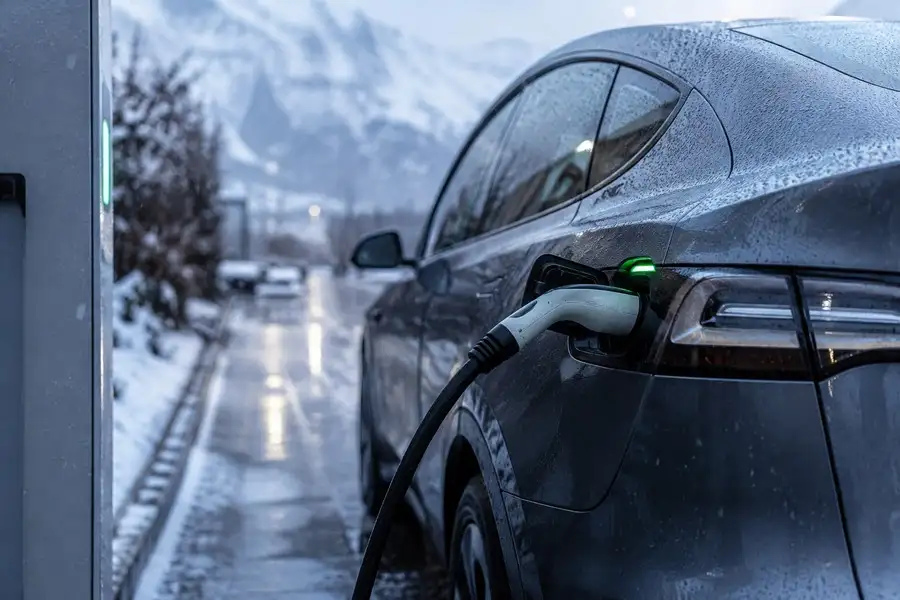
Yes, it is safe to charge an electric vehicle in the rain, provided the charging equipment is certified and undamaged. Cold weather is a different matter entirely: freezing temperatures do not make charging dangerous; they merely slow it down, and the solution to this problem is to preheat the battery. Whether you are an EV owner facing a Swiss winter or a prospective EV buyer wondering how a car copes with rain and frost, the rule of thumb is short: certified equipment and no damage for rain, a warm battery for cold.
Key Takeaways
-
Safety in the Rain: Charging an electric vehicle in the rain is safe when using certified, undamaged equipment designed for outdoor use.
-
Why it’s safe: A Type 2 connector does not allow current to flow until the electronic data exchange is complete; an IP44 rating or higher prevents water ingress; and a ground fault circuit interrupter (GFCI / RCD ) cuts off power in the event of a malfunction.
-
When to stop charging: Stop charging your electric vehicle if the cable or connector is damaged, if standing water has accumulated around the plug, or if a flood warning is in effect.
-
Cold battery: A cold EV battery charges more slowly because the battery management system (BMS) limits power output at temperatures below approximately 0 °C (32 °F) to protect the cells—not because of an electrical hazard.
-
Three helpful habits: plugging in immediately after a trip, heading to a fast-charging station to pre-condition the battery, and preheating the cabin while plugging in save the most time in winter.

Can you charge an electric car in the rain?
Yes, but under certain conditions. An electric vehicle owner can charge their vehicle in the rain if three conditions are met:
-
The charging equipment has been certified.
-
The cable and connector are not damaged.
-
There is no standing water around the plug or wall-mounted charging station.
A wall-mounted AC charging station (home charging station) is designed for everyday outdoor use and typically provides power ranging from 7.4 to 11 kW. A driver who asks, “Can I charge my electric vehicle in the rain?” at home can plug the car into an outlet on a wet driveway without taking any additional steps.
Can you charge an electric vehicle in the rain at a public charging station? Yes, a public AC charging station uses the same Type 2 (Mennekes) connector as a home wall-mounted charging station, and outdoor parking lots are its typical operating environment.
A DC fast-charging station provides power ranging from 50 kW to over 150 kW via a CCS2 connector, which adds two DC contacts to the Type 2 connector design. Can electric vehicles be charged at a fast-charging station in the rain? Yes, because the charging station only turns on the power after a connection has been established.
Is it safe to leave an electric vehicle charging overnight in the rain? Yes, the conductive contacts are located inside the Type 2 connector and the vehicle’s charging port, and the electronic data exchange and the RCD continue to monitor the charging process until morning. Overnight charging often occurs on rainy or freezing nights, so unattended charging is a standard operating scenario for electric vehicle chargers.
Why rain does not cause a risk of electric shock while charging
Is it safe to charge an electric vehicle in the rain without getting an electric shock? Yes, because the EV charger only applies voltage after the vehicle confirms a safe connection—this is the rule for Mode 3 charging, as defined in the IEC 61851-1 standard. Charging an electric vehicle in the rain follows a strict five-step process:
-
Connection: When the plug is inserted into the outlet, the ground contact (protective earth, PE) of the Type 2 connector makes contact first.
-
Detection: The vehicle detects the presence of the plug and the cable’s rated parameters using the Proximity Pilot (PP) signal.
-
Coordination: The vehicle and the charger coordinate the current value using the Control Pilot (CP) signal.
-
Power-on: Only after the vehicle sends a ready signal does the charger apply voltage.
-
Monitoring: The residual current device (RCD) monitors for current leakage throughout the entire session, including a 6 mA DC leakage, and cuts off the power if necessary.
In the first three cases, there is no voltage at the contacts; therefore, rain falling on the outer surface of the Type 2 connector does not come into contact with live parts during insertion.
In the event of a fault, the RCD cuts off the power supply when a leakage current occurs, for example, due to water ingress. The IEC 61851-1 standard permits two solutions: a Type B RCD or a Type A RCD combined with a device that trips at a steady DC leakage current of 6 mA (as specified in the IEC 62955 standard). When disconnecting from the mains, the Control Pilot and Proximity Pilot contacts open first, the power is cut off, and the ground contact opens last.
Explanation of IP Protection Classes and Weather-Resistant Charging Equipment
The IP protection rating (Ingress Protection code) is a two-digit code defined in the IEC 60529 standard by the International Electro technical Commission (IEC). The first digit indicates the degree of protection against the ingress of solid objects and dust (0 through 6), and the second digit indicates the degree of protection against water (0 through 9). The IEC 61851-1 standard establishes IP44 as the minimum requirement for charging equipment installed outdoors, while the IEC 62196 standard regulates requirements for connectors through which current flows in humid environments.
IP44, IP54, and IP55 are the protection classes most commonly specified for wall-mounted chargers installed outdoors.
|
Attribute |
IP44 |
IP54 |
IP55 |
|---|---|---|---|
|
Solid protection |
Objects larger than 1 mm |
Dust-protected (limited ingress) |
Dust-protected (limited ingress) |
|
Water protection |
Splashing water from any direction |
Splashing water from any direction |
Low-pressure water jets from any direction |
|
Typical use |
Minimum for outdoor connectors |
Dusty or exposed outdoor spots |
Exposed spots, gardens, driveways |
|
Suitable in rain |
Yes |
Yes |
Yes |
The IP55 protection rating does not apply to pressure washers. Do not direct a stream of water from a pressure washer at the wall outlet.
The number “4” in the water protection rating already implies protection against water splashes from any direction, including wind-driven rain; therefore, IP54 and IP55 ratings primarily provide additional protection against dust and resistance to water jets, rather than additional protection against rain. The protection rating indicated on the charger’s label shows the actual level of protection the owner has.
The same logic applies to a public AC charging station or a pedestal unit in a car park: check the IP and IK labels, and look for a cable holder and a sealed, drained charge port, which keep water away from the contacts. The IK protection class (IEC 62262) measures impact resistance—a property unrelated to water protection. IK08 withstands an impact of 5 joules, while IK10 withstands 20 joules, which is important for wall-mounted chargers and charging stations in public and publicly accessible parking lots.
When to Avoid Charging in Rainy Weather
Leaving an electric car charging in the rain is normal, but EV car charging during rain still has limits. It can take one of three modes: charge normally, pause, or stop and move the car. Factors such as cable damage, water accumulation, a flood warning, or a thunderstorm overhead determine which mode will be used.
Is it safe to charge a car during a thunderstorm?
It depends on the circumstances. A thunderstorm passing directly overhead is the only situation in which it is safest to pause charging, since the surge protection device (SPD) protects the charger and the car, but not a person working with the cable outdoors. MeteoSwiss issues thunderstorm warnings at danger levels 3 and 4 and sends push notifications through its app.
What should you do if the charging cable or connector is damaged?
You must stop charging. Cracks, cuts, or burns on the cable or connector compromise the protective properties of the certified weather-resistant design, so the electric vehicle owner should contact the installer or the charging station operator.
Can you charge your car if the ground is flooded or underwater?
You should pause charging or switch to a different charger if there is water around the outlet or wall-mounted charging station. A garage or covered space keeps rain off the connector, but an underground garage is among the first places to flood, so in a flash flood warning move the car to higher ground. A car that has been in a flooded area must undergo a professional inspection before being charged. The federal natural disaster portal features MeteoSwiss warnings about heavy rain and flood danger levels.
Can you use an extension cord or a household outlet outdoors?
Extension cords should not be used, and household outlets should only be used in emergencies. The Swiss Touring Club (TCS) notes that a household outlet can handle a maximum current of 8 amps during charging, while a portable cable (Mode 2) often further reduces the power output to as low as 1.8 kW. A dedicated wall-mounted charging station (Mode 3) is safer because it has its own circuit, RCD, and a data exchange protocol.
Can I charge my car right after washing it?
Yes, as soon as the wash is finished. Washing a car is about cleaning, not charging, so you should unplug the charger before the hose or high-pressure spray from the car wash gets near the charging port.
Is it safe to charge an electric car in very cold weather?
Yes, charging an electric vehicle in cold weather is safe, and the battery management system (BMS) protects the battery by reducing the charging power rather than interrupting the charging session.
Cold weather affects three parameters at the charging station: charging speed, connector stiffness, and frost formation on the charging connector. At temperatures below approximately 0 °C, many owners notice slower charging, and frosty nights in Switzerland from November through March make this a common occurrence in winter.
Cold weather does not affect the operation of the electric vehicle charger’s electrical safety mechanisms: the connection procedure, grounding, and the RCD remain unchanged. Ice and road salt exert mechanical stress on the connectors, but power is not supplied until the vehicle and the charger have established compatibility.
Why does a cold battery charge more slowly?
An electric vehicle’s lithium-ion battery charges fastest within a moderate temperature range of approximately 20 to 40 °C (68–104 °F), although the exact values of this range vary by model. Outside this range, the battery management system (BMS) reduces the charging power—a process known as derating.
A cold battery cannot safely accept current, so the car reduces its speed limit, just as highway authorities lower the speed limit on icy roads. The vehicle continues to move, just more slowly. Fast charging a cold battery creates a risk of lithium plating—a buildup of metallic lithium on the anode that reduces capacity—which is why the vehicle protects itself.
The battery thermal management system heats the battery pack to the ideal temperature range, and pre-conditioning initiates this heating process before the vehicle is connected to a DC fast charger. According to ADAC’s winter tests, a Tesla Model Y with an unheated battery took about 18 minutes to warm up before charging began, while a VW ID.3 at -7 °C (19 °F) started charging at less than 50 kW instead of the maximum 125 kW at 23 °C (73 °F).
How much slower does charging actually take at low temperatures?
The table contains data on fast-charging times from 10% to 80%, obtained from Swiss, Norwegian, and German automobile clubs.
|
Test |
Result for 10 to 80% charging |
Source |
|---|---|---|
|
TCS/NAF summer test 2022, 31 EVs |
Average of 33 minutes |
TCS |
|
NAF winter test 2025, Norway |
Most cars under 35 minutes, best under 20 minutes |
TCS |
|
ADAC winter measurement, Tesla Model Y, battery not preheated |
56 minutes instead of 33 (70% longer) |
ADAC |
|
ADAC winter measurement, VW ID.3 |
50% longer |
ADAC |
|
ADAC winter measurement, Renault Zoe and VW e-Up |
40% longer each |
ADAC |
The difference in the results of these tests points to one factor: the battery temperature at the time of startup. The ADAC describes the results of battery tests conducted without preheating, whereas the NAF’s winter tests, conducted on real roads, showed results for most vehicles that fell within the same range as the average summer performance figures. Thus, a warmed-up battery appears to eliminate most of the winter performance drop, although the tests differ in methodology, vehicle selection, and the year they were conducted; therefore, this comparison reflects a general trend rather than providing definitive proof.
How to Charge a Battery Faster in Cold Weather
Each of these winter habits costs the electric vehicle owner practically nothing: plugging into an outlet immediately after a trip requires no extra time; preheating while plugged in is powered by the grid rather than the battery; and navigating to a fast-charging station triggers the battery’s preheating process. The baseline charging time recorded during the TCS/NAF summer tests is about 33 minutes to charge from 10% to 80%, and charging a cold battery without following these habits takes longer. Below are five habits for charging an electric vehicle in cold weather, listed in order of priority:
-
Plug your car into a charger immediately after a drive. A battery that has just been driven still retains the heat generated during operation, so charging begins with a “warm” battery. A car left to cool for several hours charges more slowly.
-
Start pre-charging by entering a fast-charging station as your destination in the navigation system. Many electric vehicles initiate battery pre-charging when a DC fast-charging station is specified as the destination. However, as the ADAC notes, some cars only begin heating if the charging station is entered into the car’s own navigation system. A route set up on a phone may not trigger the preheating process.
-
Preheat the cabin while the car is connected to the charger. Preheating 15–30 minutes before departure is usually powered by the charger rather than the battery. The car sets off with a warm cabin and a fully charged battery.
-
Use scheduled charging before departure. Scheduled charging ends just before your set departure time, so the battery is already warmed up by the time you start your trip. Many manufacturers’ apps and built-in car menus offer this feature.
-
If possible, park your car under a carport. A garage or covered area helps keep the interior temperature above the freezing point outside. As a result, the car requires less heat to reach the optimal charging temperature.
Slow overnight AC charging at 3.7, 7.4, or 11 kW places much less strain on the battery than fast DC charging at 50 to 150 kW or more; therefore, overnight AC charging is less affected by low temperatures.
Limiting daily charging to 80% is suitable for batteries of many chemical compositions; however, some manufacturers recommend 100% for lithium iron phosphate (LFP) batteries, so the final decision should be made in accordance with the user manual.
What to Do If Your Charging Port or Connector Is Frozen
A frozen charging port manifests itself in four ways: a frozen cover that won’t open, a frozen latch, a stuck connector, and the inability to start a charging session. Each symptom has a single cause and a single safe solution.
Why does the charging port freeze?
Moisture from rain, wet snow, or condensation accumulates in the charging port cover, hinges, and latch, and then freezes overnight. Road salt and humidity accelerate wear on the port’s seals, and the brittle plastic in the connector’s locking mechanism causes the latch to become stiffer at sub-zero temperatures.
What should you do if the charging port cover is frozen shut and won’t open?
You’ll need to manually remove any snow and ice from the frozen charging port cover, then gently warm it—for example, by pressing a warm cloth against it. Attempting to pry the cover open with metal tools can break the hinge or damage the seal, and boiling water can damage the seal and cause it to freeze again, so neither of these methods is recommended.
What should you do if the connector is stuck in the socket?
As recommended by the Quebec-based power company Circuit Électrique, a stuck connector usually comes loose after you stop the charging session in the app or on the control panel, lock and unlock the car, and then press the unlock button while gently wiggling the connector without pulling on the cable. If the connector button is hard to press, you can loosen it by wrapping the connector in a cloth warmed on the car’s heater for a few minutes. Some cars have a manual release mechanism: the Kia owner’s manual states that if the lock freezes, you should gently pull the emergency cable two or three times.
What should I do if charging doesn't start?
Ice or snow on the connector or inside the port can prevent a secure connection, and the charger will not supply power until the connection is confirmed. You can usually resolve the issue by manually removing the ice, checking the connector for damage, and reinserting the plug; if charging still doesn’t start, try using a different charger.
How can you prevent the charging connector from freezing?
To reduce the risk of freezing, close the charging port cover immediately after disconnecting the cable, wipe any water from the port before connecting, and park the car under a carport. A cable holder prevents the port from being submerged in puddles, and some models feature a heated charging port that can be activated through the car’s menu.
Four Safe Steps If the Charging Port or Connector Freezes:
-
Stop charging and unlock the car.
-
Remove snow and ice by hand; under no circumstances should you use metal tools.
-
Gently warm the area with a warm cloth; under no circumstances should you use boiling water.
-
Use the manual release mechanism, if your model has one, and contact the charging station operator or a service center if the connector is still stuck.
Safe charging stations for apartment buildings and businesses in rainy and cold weather
Tenants, employees, and customers charge their cars in all kinds of weather, so public or commercial charging stations must be designed to withstand rain and freezing temperatures from the very beginning. According to the Federal Statistical Office, in 2025, battery-powered electric vehicles accounted for 22.7% of all new car registrations in Switzerland, and an amendment to federal law—which would allow tenants and owners of apartments in multi-unit buildings to require the installation of basic charging equipment—was open for public comment until October 12, 2026.
• Apartment buildings and shared parking lots: An underground garage is a covered space, whereas open-air parking areas require full protection from the elements. A load management system distributes the building’s limited power capacity among the many vehicles charging overnight. Most properties are not designed to handle simultaneous charging of multiple vehicles without intelligent management. The property manager or landlord must determine who will be responsible for the maintenance of the charging stations. AMP IT provides precisely this kind of intelligent management for all of its charging stations.
• Businesses: Clear rules are needed for employee, customer, and company fleet parking lots, while public charging stations require appropriate signage and neat cable routing. A cable holder keeps the connector off the ground at each parking space.
• Compliance with regulatory requirements in Switzerland: Charging stations are installed by a certified electrician, who notifies the grid operator before beginning work (ESTI Directive No. 221 includes the connection of electric vehicle charging infrastructure in the list of cases subject to notification) and documents the work performed in accordance with the Ordinance on Low-Voltage Electrical Installations (NIV) and the NIN SN 411000 standard. Property managers should check with ESTI or their local utility provider for the current notification and inspection requirements. Owners of single-family homes must hire a local licensed electrician.
For outdoor installation or installation in an open parking lot, the following six specifications must be met:
-
Enclosure with an IP54 or IP55 protection rating to protect against rain and dust
-
IK08 or IK10 impact resistance rating for public areas and shared-use areas
-
Cable holder that keeps the connector above the ground and safe from puddles
-
Ground-fault circuit interrupter (GFCI / RCD ) with a sensitivity of 6 mA DC (or a Type B RCD ) in the power supply line
-
Load control controller that distributes the building’s power among all rooms
-
Installation must be performed by a licensed electrician in accordance with the NIN SN 411000 standard
Property managers, landlords, and business owners can use these five questions as a checklist when selecting a contractor:
-
Is the device designed for outdoor use (IP and IK protection ratings)?
-
Does the package include a DC fault detection device (Type B RCD or a 6 mA DC fault detector)?
-
Does the distribution panel include a surge protection device (SPD)?
-
How does the load management system protect the building’s electrical grid when many vehicles are charging on a cold night?
-
Who performs annual inspections and maintenance on the equipment, and how are malfunctions addressed during the winter?
If you manage an apartment building or a commercial parking lot and are planning to install charging stations that will operate reliably in rain and freezing temperatures, check out our electric vehicle charging solutions for apartment buildings and commercial properties.
Charging Electric Vehicles: Myths and Facts About the Weather
Each answer begins with one of three conclusions: “False,” “Partially true,” or “True with reservations.”
Can rain cause an electric shock while charging an electric vehicle?
False. The electronic handshaking procedure ensures that the power is cut off until the vehicle and the charger establish a connection, while grounding and RCD protection ensure safety throughout the rest of the charging process (IEC 61851-1).
Is a wet connector dangerous?
True, but only under certain conditions. A wet but undamaged, certified connector is safe to use, whereas a cracked cable or water buildup around the plug poses a real danger.
Can lightning strike a car that’s charging?
Partly true. Lightning can reach a charging station through the power grid or a building, and a surge protection device (SPD) limits the magnitude of the surge reaching the charger.
Can cold weather damage the battery?
False. Normal charging in cold weather is limited by a reduction in rated power provided by the battery management system (BMS), which protects the cells from lithium deposition.
Is it true that you can’t charge an electric vehicle at temperatures below freezing?
No, that’s not true. An electric vehicle can be charged at temperatures below 0 °C (32 °F), but charging is slower until the battery warms up.
Is it necessary to install a charging station indoors?
No. An outdoor charging station with an IP44 rating or higher is designed to withstand rain, although installing it in a covered area reduces the risk of icing and wear and tear (IEC 61851-1).
Frequently Asked Questions About Charging in Rainy and Cold Weather
Can I charge my car during a heavy snowfall?
Yes. Charging works even during a snowfall and you can keep the charging port cover closed until the connector is fully inserted into the socket. Before connecting the connector, clear any snow from it and the charging port.
Should you avoid DC fast charging in very cold weather?
It depends on the circumstances. DC fast charging works even in cold weather, but a battery that hasn’t been pre-conditioned charges more slowly, which increases the stop time. Plan your route to the charging station so that the car has time to pre-condition the battery before you arrive.
Does the charging cable become stiff or crack at sub-zero temperatures?
It depends on the circumstances. In cold weather, the charging cable becomes stiff, making it harder to coil up. Uncoil the cable completely before use, and if cracks appear in the insulation, replace the cable.
Can I charge my device at a public charging station if the connector is wet or covered in snow?
Yes, as long as the connector isn’t damaged. Shake off any snow and press the button on the connector to make sure the latch moves up and down before connecting your device.
Will charging stop automatically in the event of a malfunction or water exposure?
Yes. The residual current device (RCD) and the data exchange protocol automatically interrupt the charging session if a malfunction is detected. If the error persists, please notify the charging station operator; do not attempt to restart the charging process repeatedly.
Does humidity or condensation in the garage affect the charging process?
No, not under normal conditions. The sealed design of the connectors and ports, which include drainage, provides protection against moisture. Wipe away any visible droplets from the connector and keep the port door closed between charging sessions.
Is there anything I need to do after charging in the rain?
Yes. Finish the charging session, unplug the connector, return it to its holder, and close the charging port cover. The cable, which isn’t touching the ground, will stay clean and dry.
Is slow overnight AC charging better than fast charging in cold weather?
Yes, for everyday use. Cold weather has less of an effect on slow AC charging at 7.4 or 11 kW than on fast DC charging. Plan your charging so that the battery has time to warm up before you set out.