
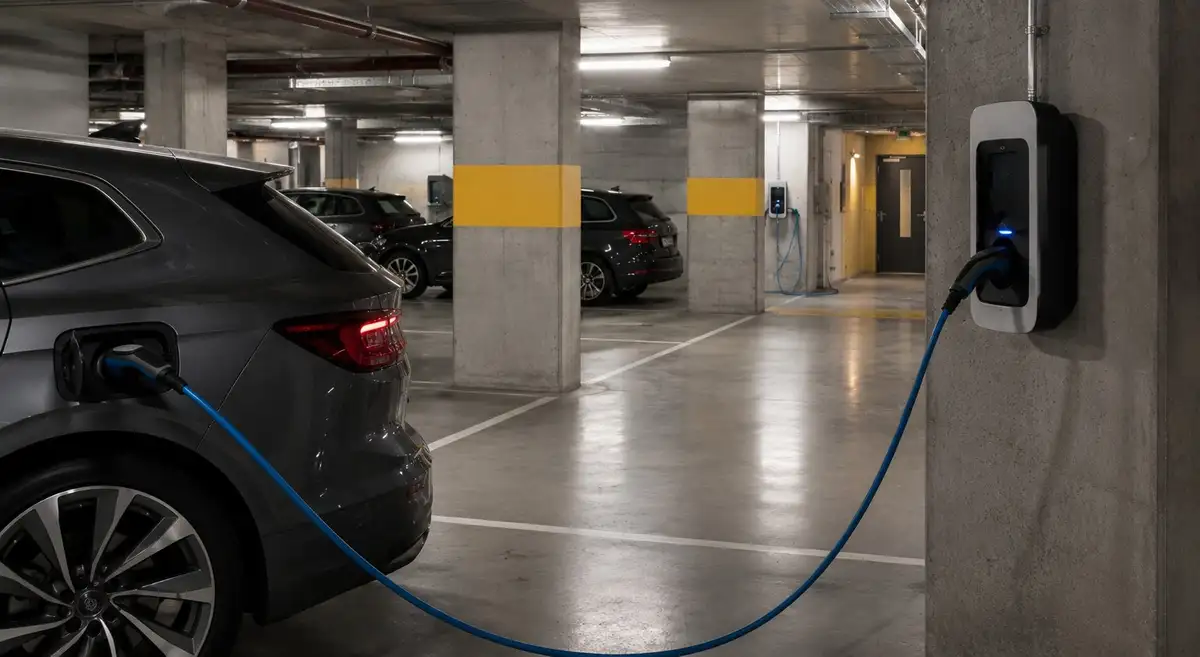
The electric car charging station installation cost in a Swiss apartment building has two separate payers: the building owner or condominium community pays the shared basic installation (Grundinstallation), which published Swiss examples put at roughly CHF 500 to 1,000 per parking space, and the resident pays the individual wallbox, indicatively CHF 2,000 to 5,500 including installation. The right to charge, which would let tenants and condominium owners demand the basic installation, is a federal draft and not yet law.
Key Takeaways
-
The shared basic installation (Grundinstallation) of a Swiss multi-family building (Mehrfamilienhaus) costs about CHF 500 to 1,000 per parking space in published examples, and the building owner or condominium community pays it first.
-
A wallbox costs the resident about CHF 2,000 to 5,500 including installation (indicative), and documented all-in offers range from CHF 1,500 to 3,000 where a basic installation already exists.
-
The pass-through to parking space rent (Parkplatzmiete) recovers the basic installation cost in rentals, while an owners’ meeting resolution decides cost allocation in a condominium (Stockwerkeigentum, StWE).
-
AMP IT HOME (purchase) becomes cheaper than AMP IT VOLT (rental) after about 5.2 years, based on the prices published on 17 November 2026.
-
The right to charge (Recht auf Laden) is a draft amendment to the Swiss Energy Act: the Federal Council’s consultation ran from 19 June to 12 October 2026, and no law is in force.
Jürg Grossen, National Councillor and sponsor of the right-to-charge motion, stated in an interview with Watson that four of five people in Switzerland cannot decide on a private charging station at their own parking space, because they rent or live in condominium ownership. Swiss eMobility, the industry association, names missing home charging as the main reason Switzerland falls behind in electric car adoption and points to the highest share of renters in Europe.

Electric Car Charging Station Cost in a Swiss Apartment Building
The electric car charging station cost in a Swiss apartment building falls on two separate payers. The building owner, or the condominium community (Stockwerkeigentümergemeinschaft), pays the shared basic installation (Grundinstallation) that serves all parking spaces. The resident who wants to charge pays for an individual wallbox, its installation, and the charging electricity.
|
Cost item |
Typical range in CHF |
Who usually pays |
|---|---|---|
|
Wallbox hardware |
approx. 500–2,500 |
Resident |
|
Installation per wallbox |
approx. 1,500–3,000 |
Resident |
|
Basic installation per parking space |
approx. 500–1,000, depending on site conditions |
Building owner, passed on via parking rent or owners’ meeting |
|
Total for the resident (hardware + installation) |
approx. 2,000–5,500 (own calculation from the two ranges above) |
Resident |
Published Swiss figures show where the basic installation price lands. A leaflet hosted by the municipality of Binningen, with prices as of 1 January 2024, lists CHF 600 to 1,000 per space for a SIA 2060 stage C1 installation including load management. Beobachter reported in 2023 that a basic installation in a building with 18 parking spaces can cost up to CHF 15,000, which equals about CHF 833 per space. Provider brochures from 2023 and 2024 report lower figures of about CHF 500 to 600 per space for residential developments.
Documented all-in offers for the wallbox side cluster between CHF 1,500 and 3,000. In the Beobachter case, a Zurich tenant found a wallbox for about CHF 700 and an electrician quote of CHF 800, while the local utility offered a purchase package of CHF 2,500 including installation. The Binningen leaflet puts the final stage of one parking space (wallbox plus installation) at about CHF 3,000.
Cantonal subsidies lower the net cost per parking space where they exist. The Canton of Zurich paid a lump sum of CHF 500 per parking space for up to 15 spaces and CHF 300 per additional space from the 16th, but its program stopped taking new applications in October 2026 after the CHF 50 million fund was exhausted. The portal energiefranken.ch lists subsidies by postal code.
What the Basic Installation Covers and Why Retrofits Cost More
The basic installation (Grundinstallation) is the shared electrical infrastructure that every individual wallbox in a multi-family building depends on. The Federal Council’s draft amendment to the Energy Act defines the basic installation as the supply line up to the parking space, a system that allocates electricity consumption to each user, and, where needed, load management.
-
Supply line (Zuleitung, Hauptverteilung, Steigzone): carries power from the main distribution through the riser to each parking space, often as a flat ribbon cable system where a back plate and wallbox are mounted later.
-
Consumption allocation system (Abrechnungssystem): meters and software assign every kilowatt-hour to the resident who charged, the way shared laundry rooms assign usage.
-
Load management (Lastmanagement): divides the available power among all charging cars and protects the grid connection from overload.
Load management determines how much grid capacity a garage needs. The municipality of Küssnacht calculates that 20 parking spaces with 11 kW wallboxes would require 220 kW if all cars charged at the same time. The Binningen leaflet states that a 63-ampere (43 kW) connection combined with load management can serve at least 50 electric cars.
The SIA 2060 standard describes the build-out in stages. Stage C1 (“Power to garage”) brings power to the garage, stage C2 (“Power to parking”) brings power to each space, and stage D (“Ready to charge”) equips a space with a charging station (SVIT). Pre-installation (Vorinstallation) at stage C1 or C2 reduces the retrofit work per parking space later.
Retrofits raise the electric car charging station installation cost for three reasons. Cable routes must pass through existing ceilings and walls, the grid connection (Netzanschluss) may need an upgrade, and the installation must be dimensioned for all parking spaces even if only a few residents start. The Binningen leaflet gives CHF 600 to 1,000 per space depending on size and situation, while lower figures of CHF 500 to 600 come from developments where the cabling was planned together with the building.
Who Pays for the Charging Station in a Rental Apartment
In a Swiss rental building, the landlord decides whether a charging station may be installed, because tenants have no statutory claim to one today. A tenant needs the written consent of the landlord or property manager before any installation. The electric car charging station cost a tenant carries is the wallbox plus its installation, while the landlord carries the basic installation first.
-
No charging infrastructure yet: the landlord builds the basic installation and recovers its cost through the parking space rent, and the SVIT billing recommendation of May 2024 amortizes that investment fully through rent over the system’s service life. The tenant pays the wallbox and installation, or advances costs under a written agreement.
-
Basic installation already built: the tenant buys or rents a compatible wallbox through the property manager. The tenant pays about CHF 1,500 to 3,000 for a documented all-in purchase offer, or a monthly rental fee, and applies to the property manager first.
-
Landlord refuses: no legal claim exists today. The Federal Council’s draft would let a tenant demand the basic installation if the measure is reasonable (Zumutbarkeit).
The Beobachter case of 10 May 2023 shows why the parking space rent matters more than the hardware price. A tenant in a new Zurich housing development, where the foundation had built the basic installation into the walls, found a wallbox for about CHF 700 and an electrician quote of CHF 800. The management refused, because the local utility had built the basic installation and offered only a rental model at CHF 49.90 per month (CHF 35 device rental plus CHF 14.90 for remote maintenance and billing), which raised the parking space cost by about CHF 600 per year. A purchase through the utility would have cost CHF 2,500 including installation.
Over ten years, the utility’s CHF 49.90 per month totals about CHF 5,988 (own calculation), compared with CHF 1,500 for the retail wallbox plus electrician quote. The rental package includes remote maintenance and billing, so the two figures cover different services, but the recurring fee passes the hardware price after about 2.5 years. An expert from the industry association Electrosuisse judged the utility’s offer fair on closer inspection, because a wallbox in a multi-family building must connect to the load management of the basic installation.
HEV Schweiz, the Swiss homeowners’ association, publishes a model agreement for landlords with two common variants: permission with an obligation to remove the wallbox, or permission without removal obligation and without compensation. The Swiss Tenants’ Association (Mieterinnen- und Mieterverband) is a point of contact for tenants who dispute a parking space rent increase. Tenants should ask in writing for consent, ownership of the wallbox, and the rule for move-out.
Who Pays and Who Decides in a Condominium (StWE)
In Swiss condominium ownership (Stockwerkeigentum, StWE), the underground garage, its cables, and its connections are usually common property, so a condominium owner cannot install a wallbox alone. The St. Gallen Cantonal Court held on 15 December 2021 that attaching a charging station at an owner’s garage space is a structural measure under Articles 647c to 647e of the Swiss Civil Code.
HEV Schweiz guidance distinguishes three variants: the community builds everything, the community builds the basic installation and each owner builds the final stage, or an individual owner builds both. Two of these variants are the real choice for most communities:
-
Model A, the community builds the basic installation: the owners’ meeting resolves the shared infrastructure, and each owner pays only the final stage (the wallbox). Model A needs a community resolution but avoids the first-mover problem.
-
Model B, an individual owner builds both: the owner pays the basic installation and the wallbox at own expense and needs approval, because common parts are affected. SVIT guidance says later owners who add a charging station contribute an appropriate share of the first owner’s planning, permit, and construction costs, so the electric car charging station installation cost lands first on the applicant, and Model B is faster but leaves the first owner prefinancing infrastructure that others use later.
Under the prevailing view reported by SVIT, a charging installation counts as a useful structural measure (nützliche bauliche Massnahme) under Article 647d of the Swiss Civil Code. Such a measure needs the approval of a majority of owners who also represent the larger share of the property, a double majority by heads and value shares. An owner who would be significantly and permanently restricted in using the unit holds a veto under Article 647d paragraph 2, and the owners’ regulations may set stricter rules, so a lawyer or HEV Schweiz should confirm the required majority before the vote.
Costs borne by the community are allocated by value shares (Wertquoten) unless the owners’ regulations or a resolution say otherwise. One practical tip: the property manager (Hausverwaltung) should put load management, the cost allocation key, and the expected condo maintenance fee for the shared system into one proposal on the owners’ meeting agenda. Guidance for condominium communities recommends a complete resolution that settles these points together.
Financing Models: Purchase, Rental, and Operator Financing
Three financing models cover charging in Swiss apartment buildings: purchase of the charging point, rental or subscription, and operator financing (contracting), where a provider funds the infrastructure and recovers its costs through monthly fees. The electric car charging station cost for a resident depends on which model the building offers and on whether a basic installation already exists.
For Residents: Purchase, Rental, or Management of an Existing Installation
AMP IT offers three resident plans, priced per charging point.
|
Plan |
Model |
Upfront / activation |
Monthly cost per charging point |
|---|---|---|---|
|
AMP IT VOLT (most popular) |
Rental of the charging point |
No start-up fee; activation CHF 250 |
CHF 55 |
|
AMP IT HOME |
Purchase of the charging point |
Purchase price CHF 2,190; activation CHF 250 |
CHF 20 |
|
AMP IT OPERATOR |
Management of an existing installation |
Activation CHF 250 |
CHF 10 |
All three AMP IT plans include automatic monthly billing, charging scheduling, after-sales service, and a web portal with a mobile app. Tariffs are adapted to the specificities of each canton.
For Building Owners: EASY, INVEST, and OPERATOR
AMP IT offers building owners and property managers three financing models that differ by who invests and who receives the subscription revenue. In AMP IT EASY, AMP IT invests and keeps the revenue. In AMP IT INVEST, AMP IT co-invests and shares the subscription revenue with the owner, and in AMP IT OPERATOR, the owner invests and receives the majority of the revenue.
In a condominium, the owners’ meeting must approve the chosen financing model before any contract is signed. Some cantons subsidize up to 50% of the project cost and lists no increase in power supply as a benefit for residential buildings.
Maintenance Fee for Condo Charging Infrastructure and Other Running Costs
Running costs of a charging system are separate from installation costs and recur every month or year. In a condo, the maintenance fee for shared charging infrastructure is allocated by the owners’ community, normally by value shares, unless the regulations say otherwise.
-
Maintenance, repair, and renewal of the basic installation: the owners’ community decides by resolution in a condominium, and the landlord bears these costs in a rental, where SVIT says repairs are not chargeable as ancillary costs.
-
Software, backend, and service provider: a provider fee, often a base fee per parking space with a basic installation, covers load management, monitoring, and billing support.
-
Internet subscription and utility base fee: SVIT allows both to be spread across all parking spaces with a basic installation.
-
Standby consumption of wallboxes: the difference between the meter reading and the energy charged is allocated to the users or the community.
-
Property management fees: the property manager (Hausverwaltung) charges for administering maintenance contracts and billing.
-
Insurance and liability of shared parts: the owners’ community agrees the coverage in the maintenance contract.
How AMP IT Handles Maintenance and Operation
AMP IT includes after-sales service in every plan, runs remote management through the AMP IT Hub software, and lists 24/7 technical support for residential buildings. AMP IT OPERATOR takes over the management of existing installations for CHF 10 per month per charging point plus a CHF 250 activation fee, and a free study of an existing installation is available on request. The equipment and installation carry a 5-year warranty with local technical support.
|
Cost type |
Usually borne by |
What AMP IT offers |
|---|---|---|
|
Maintenance and after-sales service |
Owners’ community or landlord |
After-sales service included in all plans; 24/7 technical support listed on the real estate page |
|
Software and backend |
Owners’ community or landlord |
Web portal and mobile app included; management through AMP IT Hub |
|
Metering and billing administration |
Property manager |
Automatic monthly billing included |
|
Warranty and repairs |
Owner |
5-year warranty on equipment and installation with local technical support |
|
Existing installations |
Owners’ community |
AMP IT OPERATOR, CHF 10 per month per charging point, activation CHF 250 |
|
Insurance of shared parts |
Owners’ community |
To be agreed in the maintenance contract |
SVIT’s billing recommendation assumes that the community operates and maintains the basic installation. Owners should therefore define who operates the system, who pays maintenance, and who handles support before the first wallbox goes live.
What Charging Electricity Costs per Year
Charging electricity is a running cost billed per kilowatt-hour (kWh), separate from the one-time installation cost. The yearly amount depends on the driver’s mileage and on the tariff of the local grid operator.
A driver who covers 15,000 km per year at 18 kWh per 100 km uses about 2,700 kWh per year (assumption). At the 2026 Swiss median household tariff of 27.7 Rappen per kWh (CHF 0.277) published by the Swiss Federal Electricity Commission (ElCom), 2,700 kWh costs about CHF 748 per year, and at the 2027 median of 26.5 Rappen per kWh (CHF 0.265), about CHF 716. These electricity costs recur every year and are separate from the one-time electric car charging station cost of the wallbox.
Local tariffs vary widely. Ferrera in Graubünden has the lowest 2027 household tariff in Switzerland at 10.56 Rappen per kWh (CHF 0.1056), while Bergün Filisur in the same canton charges 36.29 Rappen per kWh (CHF 0.3629), so the same 2,700 kWh would cost about CHF 285 in Ferrera and CHF 980 in Bergün Filisur. These figures use household tariffs as a proxy, and a building may bill charging electricity under its own e-mobility tariff.
A self-consumption community (Zusammenschluss zum Eigenverbrauch, ZEV) can bill self-produced solar power to users at a lower price per kWh. AMP IT reports a 40% reduction in charging costs at an office site in Geneva that uses charging management to maximize solar self-consumption.
How the consumption of each parking space is measured and invoiced to each resident is covered in a separate guide on how EV charging is metered and billed per user.
Right to Charge in Switzerland and the Energy Act Amendment
The right to charge (Recht auf Laden) is a proposed federal rule that would let tenants and condominium owners demand the basic installation for charging electric vehicles at their parking space. The Federal Council sent the amendment to the Energy Act into consultation on 19 June 2026 to implement motion 23.3936, and the responses went to the Federal Office of Energy (BFE) within the Federal Department DETEC.
Motion 23.3936, titled “Laden von Elektroautos im Mietverhältnis und Stockwerkeigentum,” was submitted in 2023 by National Councillor Jürg Grossen. The National Council and the Council of States adopted the motion in June 2025 against the Federal Council’s wishes.
-
Owners of residential properties could be obliged to build the basic installation when tenants, subtenants, or condominium owners request it, provided the measure is reasonable (Zumutbarkeit).
-
The costs of the basic installation could normally be passed on via the parking space rent.
-
Disputes about the obligation would be decided by civil courts.
-
The wallbox itself would remain the expense of the electric car driver.
|
Today |
Proposed in the draft |
|---|---|
|
Owners or the community can refuse |
Obligation if reasonable; costs normally passed on via parking space rent; disputes before civil courts |
Who Supports and Who Opposes
-
Supporters: Swiss eMobility, VCS, Auto-Schweiz, the GLP, the SP, the Greens, and Casafair back the draft, and several of them (SP, Casafair, VCS, Swiss eMobility, Auto-Schweiz) ask the law to define reasonableness more precisely.
-
Opponents: Die Mitte, the SVP, HEV Schweiz, and the real estate association SVIT oppose the draft, and they warn of state compulsion over property, higher housing costs, and open practical questions.
The Swiss Federation of Trade Unions raises a separate concern: owners who equip a whole parking area should pass on only the basic infrastructure cost and should not charge unaffected parking space renters for more.
Current Status of the Right to Charge
As of 17 November 2026, the right to charge is a draft and not in force. The consultation opened on 19 June 2026 and closed on 12 October 2026, and the legal text still has to be finalized before the Federal Council submits a message to Parliament (next step pending, not yet confirmed). Drivers without home charging, known in German as Laternenlader, rely on more expensive public charging, which the draft aims to make avoidable.
-
2023: motion 23.3936 submitted by Jürg Grossen
-
June 2025: Parliament adopts the motion
-
19 June 2026: Federal Council opens the consultation on the Energy Act amendment
-
12 October 2026: consultation ends
-
Next: Federal Council message to Parliament (pending, not yet law)
Step by Step From Request to Working Wallbox
AMP IT handles the technical study, installation, commissioning, and operation, and a certified electrician carries out the installation. Six steps lead from the first request to a working wallbox.
-
Request a free quote. The property manager, owner, or resident fills in the quote form and chooses a plan or financing model. The reader provides the address, the number of parking spaces, and the garage type (underground or outdoor).
-
Technical study. AMP IT studies the site and dimensions of the installation, including dynamic load management. Usually, no increase of the supply power is needed for residential buildings.
-
Agreement and financing. The owner or community selects AMP IT EASY, INVEST, or OPERATOR, or the resident selects AMP IT VOLT, HOME, or OPERATOR (see the plans and financing models). In a condominium, the owners’ meeting decides first.
-
Installation. A certified electrician installs the system according to SIA 2060 and cantonal regulations, and the installation step covers the notification to the grid operator and any required permit.
-
Commissioning and activation. AMP IT charges an activation fee of CHF 250 per charging point, and residents receive access to the web portal and the mobile app.
-
Operation. AMP IT provides automatic monthly billing, charging scheduling, after-sales service, and a 5-year warranty on equipment and installation.
The electric car charging station installation cost for the whole process is made of these figures: an activation fee of CHF 250, monthly plans from CHF 10 to CHF 55 per charging point, and a purchase price of CHF 2,190 for AMP IT HOME. A copyable checklist helps the application go through without delays:
-
Written consent of the landlord, or the owners’ meeting resolution
-
Number and location of the parking spaces
-
Existing electrical documentation
-
Choice of financing model
-
Cost allocation agreement: who pays, who owns the charging point, and what happens on move-out
Get a free quote or see AMP IT’s residential projects, which number more than 25 projects. Cantonal energy agencies and energy advisors can confirm which subsidies apply to a building before the quote is signed.
Frequently Asked Questions
Can my landlord refuse a charging station in Switzerland? Yes, a Swiss landlord can refuse a charging station today, because tenants have no statutory right to one. The Federal Council’s draft amendment to the Energy Act would oblige owners to build the basic installation when a tenant requests it and the measure is reasonable (zumutbar), but the draft is not in force.
Who pays for the charging station in a rental apartment? The tenant pays the wallbox and its installation, and the landlord pays the basic installation first. The landlord usually recovers the basic installation through the parking space rent, which the Federal Council’s draft also names as the normal route. In the Beobachter case, a monthly package of CHF 49.90 added about CHF 600 per year to the parking space cost.
Do I need an owners’ meeting vote for a wallbox in a condominium? Yes, a condominium owner generally needs an owners’ meeting resolution, because the garage and its supply lines are common property. Under the prevailing view, the resolution requires a majority of owners who also hold the larger share of the value shares (Article 647d of the Swiss Civil Code).
How much does a wallbox cost in Switzerland including installation? A wallbox with installation costs a resident about CHF 2,000 to 5,500 on an indicative basis, and documented all-in offers range from CHF 1,500 to 3,000 where a basic installation exists. The range combines hardware of CHF 500 to 2,500 with installation of CHF 1,500 to 3,000, and the electric car charging station installation cost rises with cable length and load management requirements.
Does a charging station increase the value of an apartment building? Yes, the Binningen leaflet lists a value increase as a benefit, and buildings with charging infrastructure are generally easier to rent. No verified Swiss study cited here puts a percentage on the effect.
What is the maintenance fee for condo charging infrastructure? A condo maintenance fee for charging infrastructure is set by the owners’ community and not by law, and the cost is split by value shares unless the regulations say otherwise. A provider fee runs, for example, CHF 10 per month per charging point for AMP IT OPERATOR.
Is there a legal right to charge in Switzerland? No, Switzerland has no legal right to charge in force as of 17 November 2026. The Federal Council opened a consultation on 19 June 2026 that ended on 12 October 2026, and the Federal Council still has to submit a message to Parliament.